anywidget-instruments-automotive
Automotive instruments for computational notebooks: speedometer, tachometer, fuel and temperature gauges, tell-tales, a trip computer display, gear and shift indicators, the indicators of electric and hybrid drivetrains, and a head-up display mode.
Part of the anywidget instruments family: the core, the industrial, automotive and aeronautics widget libraries, their hosts (Python, Julia, Grafana) and their live demos.
A TypeScript front end first, built on anywidget and on anywidget-instruments, whose front end, trait contract and themes it extends. The front end computes everything a widget shows — unit conversion included — from a dictionary of traits, so the widgets behave alike in every host: Python (JupyterLab, Jupyter Notebook 7, marimo, VS Code, Google Colab), Julia (KaimonSlate.jl), Rust or a plain web page — with no JavaScript toolchain and no network access at runtime.
Status: early implementation
Every widget of the catalog is written — electric and hybrid
drivetrains, the Cluster and its head-up display mode included — and used from
Python; click a picture to open it in a notebook. Hosts beyond Python, the
legibility rules and a first release are next: the roadmap orders
them, and the requirements status shows where each
requirement of the specification stands.
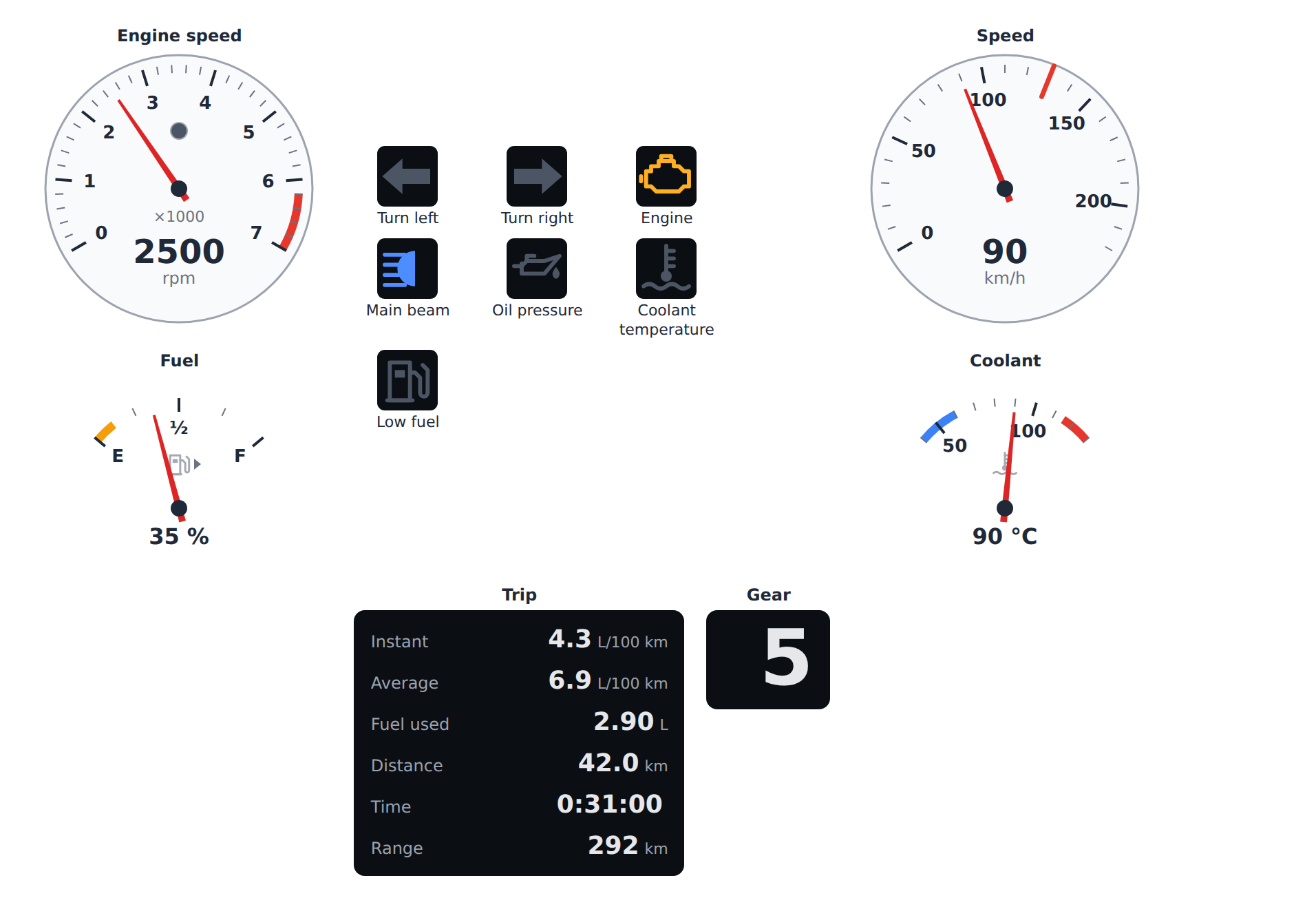
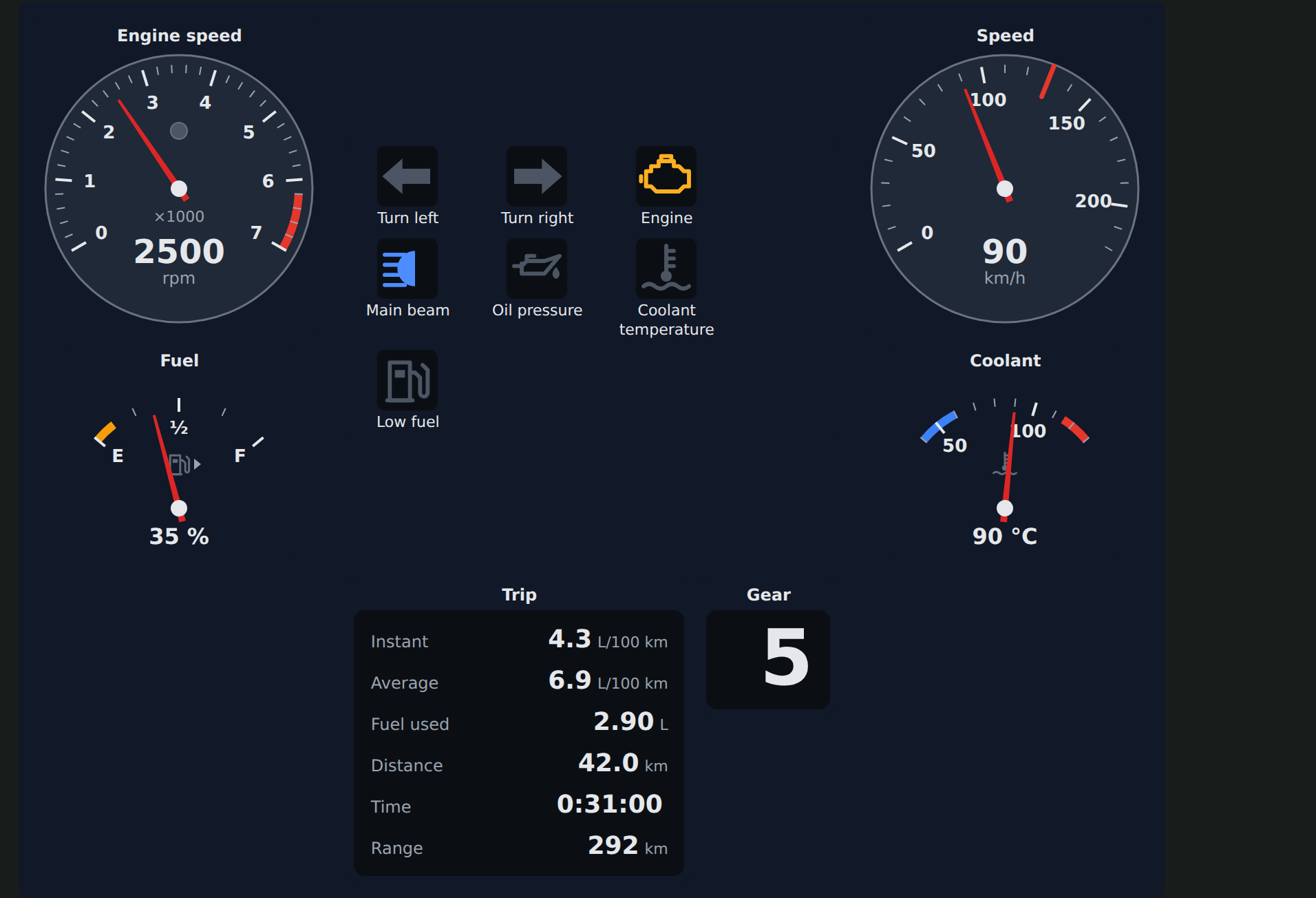
The cluster example: one Cluster of the widgets of
anywidget-instruments-automotive. The figures are simulated.
Safety
The widgets are for visualization, teaching, simulation and aftermarket dashboards. They are not vehicle instruments: they are not type-approved, and they must not replace a vehicle's speedometer, odometer or tell-tales, nor be operated while driving. Read the safety notice first. The automotive standards that inform the design are listed in Standards and references; the library does not claim conformity with them.
Why not anywidget-instruments?
anywidget-instruments speaks the language of process plants: ISA-101 grey-scale screens, IEC 60073 colours, ISA-18 annunciators. A vehicle display speaks another:
| Concern | Industrial convention | Automotive convention |
|---|---|---|
| Warning colours | IEC 60073 | UN Regulation No. 121 and ISO 2575: red for danger, yellow/amber for warning, green for a function on, blue for high beam |
| Symbols | ISA-5.1 | ISO 2575 tell-tale symbols |
| Speed display | — | UN Regulation No. 39: a speedometer never shows less than the true speed |
| Legibility | WCAG contrast | ISO 15008: character size as a visual angle, day and night luminance |
| Attention | Operator at a console | Driver at the wheel: short glances, few items, no distracting motion |
Those conventions live in their own package, which depends on anywidget-instruments rather than bending it.
Use
import anywidget_instruments_automotive as aa

speed = aa.Speedometer(0, max=220, unit="km/h")
rpm = aa.Tachometer(0, max=7000, redline=6000)
engine = aa.TellTale("engine", state="off")

aa.Cluster([speed, rpm, engine])
- Widget catalog — every widget, and the convention it follows
- Hosts — Python, a web page, Julia (KaimonSlate.jl), Rust
- Development — building, testing, the trait contract
- Head-up display mode — mirrored, black, one colour
- Use with CAN & CANopen Studio — live data from an OBD-II adapter
- Specification — requirements in EARS notation
Related projects
| Project | What it is | Documentation |
|---|---|---|
| anywidget-instruments | Core of the family: base view and class, trait contract, themes, liveness | https://anywidgetinstruments.github.io/anywidget-instruments/ |
| anywidget-instruments-industrial | Instrumentation widgets for notebooks: gauges, tanks, LEDs, switches, charts, alarms, SCADA objects | https://anywidgetinstruments.github.io/anywidget-instruments-industrial/ |
| anywidget-instruments-automotive | Automotive instruments built on anywidget-instruments | https://anywidgetinstruments.github.io/anywidget-instruments-automotive/ |
| afm-host-panel | Grafana panel plugin that runs anywidget modules, with both libraries built in | https://anywidgetinstruments.github.io/afm-host-panel/ |