AlarmList
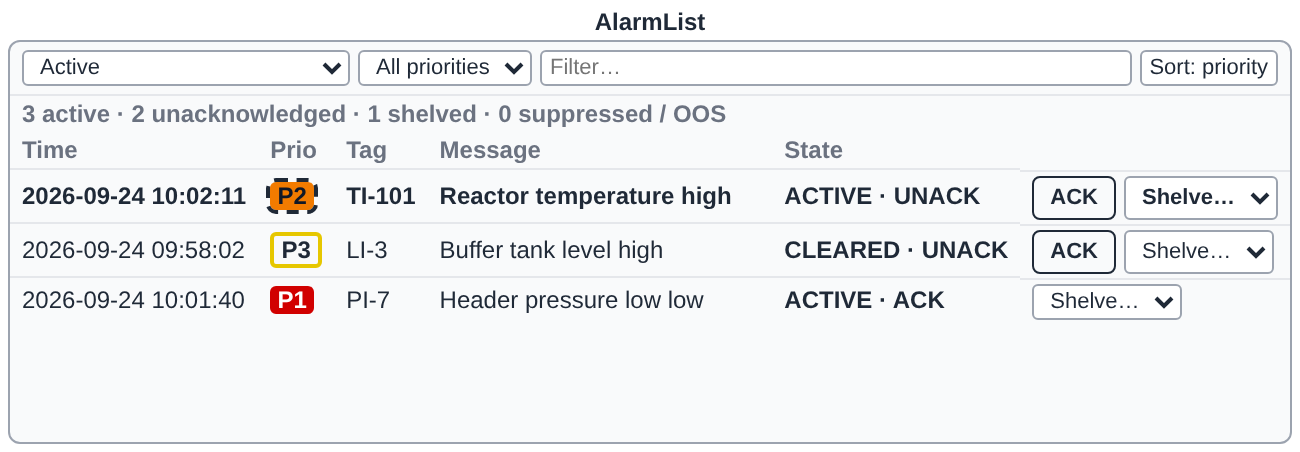
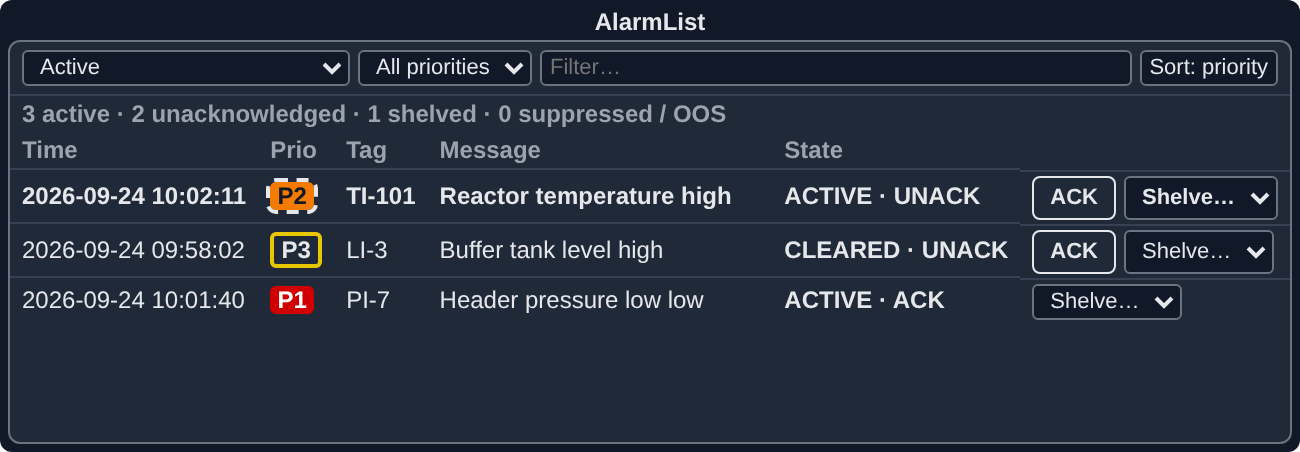
Alarm summary table with shelving, suppression and out-of-service states (IND-050 .. IND-053).
Not a safety-related system
The alarms shown here may be delayed, lost or stale. It is for visualization, teaching, simulation and supervision; it is not a safety-related system and must not perform a safety function. See the safety notice.
Alarms and events · Widget catalog · API reference ·
schema alarmlist.schema.json
Example
The traits of the picture above:
ai.AlarmList(label="AlarmList", size=(640, 200))
Traits
| Trait | Type | Default | Set by | Description |
|---|---|---|---|---|
size |
array | [640,240] |
host | [width, height] in CSS pixels. |
value |
array of object | [] |
derived | Alarms {id, timestamp, source, priority, message, state, shelved_until, suppressed, out_of_service}. Written by the host (Python: raise_alarm(), suppress(), ...); without a host owning the state, the front end applies acknowledgements, shelving and its expiry, and writes the list back (HOST-004, HOST-012). |
shelve_durations |
array of number | [300,900,3600] |
host | Shelving durations offered, in seconds. |
max_shelve |
number | 28800 |
host | Longest shelving allowed, in seconds (IND-051). |
Common traits (8), shared with other widgets
| Trait | Type | Default | Set by | Description |
|---|---|---|---|---|
mode |
"control", "indicator" |
"control" |
host | "control": the user sets the value; "indicator": display only. |
label |
string | "" |
host | Plain text, never interpreted as HTML (SEC-002). |
disabled |
boolean | false |
host | Greyed out, input rejected. |
visible |
boolean | true |
host | |
tooltip |
string | "" |
host | Plain text shown on hover. |
style |
"modern", "classic", "system" |
"modern" |
host | |
theme |
"auto", "light", "dark", "system" |
"auto" |
host | "auto": the style decides; "system": the host page or the operating system (STYLE-007). |
skin |
object | {} |
host | Replaceable drawing parts: part name -> SVG source, sanitized (STYLE-005, STYLE-006). |
Set by: host, the program (Python, Julia, ...); widget, the user through the widget;
derived, computed from other traits by the host that owns the state, or by the widget.
See the trait contract.